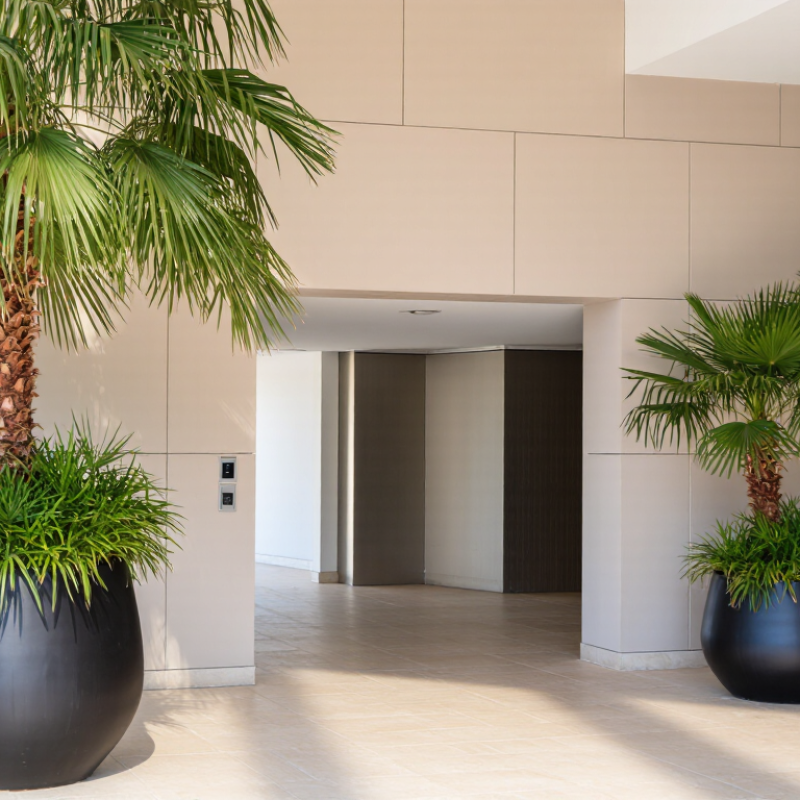
Global sourcing decisions are rarely based on appearance alone. Tall Artificial Plants offer a practical way to create visual impact in hotels, offices, retail stores, and residential developments. Their height can fill empty corners, frame entrances, and soften large architectural spaces without demanding daily watering or sunlight.
Experienced buyers usually examine more than photographs. They check leaf density, trunk stability, pot dimensions, packaging strength, and color consistency between samples and bulk orders. A realistic artificial palm may look convincing online, yet its leaves can arrive bent after long-distance transport. Careful suppliers provide detailed product specifications, material information, production samples, and inspection records. These steps support better decisions and reduce avoidable sourcing risks.
Quality still varies.
Reliable manufacturers should explain their production process clearly. They should also discuss UV resistance, odor control, recyclable packaging options, and applicable safety requirements for the destination market. These details matter when plants are installed near windows, public walkways, or frequently touched furniture. In my sourcing experience, the cheapest quote is not always the lowest total cost. Weak bases, thin foliage, and poor cartons can create replacement expenses later. However, “low maintenance” does not mean maintenance-free. Dust still gathers on broad leaves, and fading can occur in strong sunlight. Buyers should test products under real conditions before placing large orders. One overlooked detail can change the entire result. Choosing Tall Artificial Plants becomes more reliable when design appeal, manufacturing capability, product testing, logistics planning, and long-term performance are evaluated together.
Market Demand: Artificial Plant Sales Forecast at 5.9% CAGR Through 2030
Why Choose Tall Artificial Plants for Global Sourcing?
Demand for artificial plants is moving beyond seasonal decoration. The market forecast indicates sales may grow at a 5.9% CAGR through 2030, according to industry outlooks from Grand View Research and Research and Markets. Forecasts differ by product category, so buyers should treat the figure as a planning signal, not a guarantee.
Tall artificial plants fit hotels, offices, restaurants, and apartment lobbies with limited natural light. A 1.8-meter plant can fill an empty corner without irrigation, soil replacement, or daily maintenance. This practical value supports repeat demand across commercial projects. It also simplifies international sourcing. Buyers can compare pot size, foliage density, stem flexibility, carton volume, and UV resistance before ordering.
Small details matter.
In supplier evaluations, I would request close-up photos of leaf veins, base stability, and packed cartons. A plant that looks realistic online may appear flat under bright showroom lighting. Packaging can also turn a profitable order into waste if stems bend during transit. Customs rules, material declarations, and accurate product descriptions must be checked for each destination. The market outlook is encouraging, yet quality consistency remains uneven. That weakness deserves honest attention before large-volume purchasing.
Product Selection: Compare Height, Materials, UV Resistance, and Realism
Height, Materials, UV Resistance, and Realism in Tall Artificial Plants
Choosing tall artificial plants for global sourcing requires more than selecting the largest available model. Measure the finished height against ceiling clearance, doorways, and shipping cartons. A 1.8-meter plant may suit a reception area, while a 2.4-meter design can overwhelm a low retail ceiling. I have seen buyers overlook pot height, creating costly installation problems.
Material selection affects appearance, durability, and freight planning. Polyethylene leaves usually offer sharper textures, while PVC can provide flexibility at a lower cost. Polyester may create softer, fabric-like foliage, but it can collect dust more visibly. Metal or reinforced plastic stems improve stability. Ask for material specifications, weight details, and sample photos before approving bulk production.
UV resistance deserves careful verification. “UV resistant” should include test conditions, exposure duration, and expected color retention. Outdoor performance depends on sunlight, heat, humidity, and placement. Request an independent test report when possible. Realism comes from varied leaf angles, natural color changes, matte surfaces, and slight asymmetry. Perfectly identical leaves often look artificial. Too much variation can also appear careless. A sample review should include close-up images, stem strength checks, and viewing distance tests. I would not rely on one showroom light; daylight can reveal glossy leaves and uneven coloring. Bulk inspection remains necessary, because production batches sometimes differ from approved samples.
Compliance Standards: Verify ASTM E84 and EN 13501-1 Fire Performance
Why Choose Tall Artificial Plants for Global Sourcing?
Tall artificial plants can create a strong visual feature in hotels, offices, and retail spaces without regular watering. Their height also helps divide large interiors with limited construction work. Yet appearance should not lead the purchasing decision. Fire performance matters, especially when plants stand near lighting, exits, or busy walkways.
Ask suppliers for test reports covering ASTM E84 and EN 13501-1. ASTM E84 evaluates surface flame spread and smoke development under controlled conditions. EN 13501-1 classifies reaction to fire using European test methods and rating categories. These standards are not interchangeable. A report for one leaf fabric may not cover the complete plant, pot, foam, or trunk.
Check the tested material, thickness, backing, production date, and laboratory details. The product delivered should match the tested sample. Small changes can matter. A darker coating, denser foliage, or different plastic pot may alter performance. Request clear documents before approving a global order.
In sourcing reviews, a recurring mistake is accepting a general “fire retardant” statement as proof. It is not enough.
I would also inspect sample leaves, stems, and packaging for consistent labeling. Ask whether certificates remain valid for the intended market and installation setting. Requirements can differ between countries, building types, and project specifications. Documentation may look complete, yet one missing component can weaken the assessment. That uncomfortable gap deserves attention before shipment.
Sourcing Economics: Evaluate MOQ, Freight Volume, Lead Times, and Total Cost
Tall artificial plants look simple, but their sourcing economics can be surprisingly complex. For global sourcing, the quoted unit price is only one part of the decision. MOQ may reduce production, packing, and labor costs, but it can also trap cash in slow-moving colors. A practical buyer compares MOQ with monthly sales, warehouse capacity, and seasonal demand. Start small. A 200-piece trial order can reveal packaging weaknesses before a 2,000-piece commitment.
Freight volume deserves close attention because tall plants consume space, even when they are lightweight. Measure packed height, carton dimensions, and stackability, not only product weight. For example, a 1.8-meter plant may fit efficiently in a reinforced carton, while an oversized pot creates costly empty space. Request a carton-level packing list and calculate cubic-meter freight before negotiation. One overlooked detail matters. A small carton-height reduction can lower freight across hundreds of units. However, aggressive compression may bend stems or damage leaves.
Lead time should include sampling, material preparation, production, inspection, and port handling. A quoted 30-day production window is not a delivery date. Build a buffer for holiday closures and transport delays. Total cost should combine product, packaging, inland transport, freight, duties, inspection, storage, and defect replacement. In one internal estimate, the cheapest offer became more expensive after low-density cartons required extra warehouse space. That mistake was ours. Recheck assumptions with real carton data, updated freight quotes, and conservative sales forecasts.
Why Choose Tall Artificial Plants for Global Sourcing? - Sourcing Economics: Evaluate MOQ, Freight Volume, Lead Times, and Total Cost
Indicative planning benchmarks for one 40-foot-high-cube container shipment. Actual quotations vary by supplier, origin, destination, season, packaging, trade terms, duties, and taxes.
| Plant Height |
Typical Packed Carton Size |
Carton Volume
(CBM/Unit) |
Indicative MOQ
(Units) |
Freight Volume at MOQ
(CBM) |
Production Lead Time |
EXW Cost
(USD/Unit) |
Estimated Freight & Handling
(USD/Unit) |
Estimated Landed Cost Before Duty/Tax
(USD/Unit) |
Estimated Total Cost at MOQ
(USD) |
120 cm
Compact floor plant |
25 × 25 × 125 cm |
0.078 |
100 |
7.8 |
35–45 days |
$18.00 |
$17.76 |
$35.76 |
$3,576 |
150 cm
Residential and office format |
28 × 28 × 155 cm |
0.122 |
100 |
12.2 |
40–50 days |
$24.00 |
$26.07 |
$50.07 |
$5,007 |
180 cm
High-demand commercial size |
30 × 30 × 185 cm |
0.167 |
100 |
16.7 |
45–55 days |
$31.00 |
$34.67 |
$65.67 |
$6,567 |
210 cm
Tall statement plant |
35 × 35 × 215 cm |
0.263 |
80 |
21.1 |
50–60 days |
$42.00 |
$53.11 |
$95.11 |
$7,609 |
240 cm
Large hospitality and retail format |
38 × 38 × 245 cm |
0.354 |
60 |
21.2 |
55–65 days |
$56.00 |
$69.88 |
$125.88 |
$7,553 |
Calculation assumptions:
Freight and handling estimates use an indicative ocean-freight planning rate of $180 per CBM plus approximately $1.20 per unit for shipment-level allocation and destination handling of $2.50–$5.00 per unit. Estimated landed cost equals EXW cost plus freight and handling. Import duty, VAT/GST, customs brokerage, insurance, inland delivery, warehousing, and financing costs are excluded.
Supplier Quality Control: Require ISO 9001 Processes and Pre-Shipment Inspections
Why Choose Tall Artificial Plants for Global Sourcing?
Supplier Quality Control: Require ISO 9001 Processes and Pre-Shipment Inspections
Tall artificial plants can look impressive in a showroom, yet quality problems often appear after delivery. A reliable supplier should operate documented ISO 9001 quality processes. These procedures should cover incoming materials, production checks, defect records, and corrective actions. Ask for process evidence, not only a certificate. Review inspection forms, training records, and sample approval procedures.
During production, inspectors should check stem strength, leaf attachment, color consistency, pot dimensions, and overall height. Small differences become obvious when several plants stand together. I have found that measuring only one sample is not enough. Random checks from different cartons reveal more practical risks. The supplier should also test packaging strength, especially when plants travel long distances. Crushed cartons can bend stems and damage decorative pots.
A pre-shipment inspection should confirm quantity, workmanship, packing, labels, and approved samples. Use clear acceptance standards with photographs and measurable limits. Check unstable bases, loose foliage, strong odors, dust, and mismatched accessories. The report should include carton numbers and inspection images. Independent inspection adds useful distance between production pressure and purchasing decisions. It is not perfect. Inspectors can miss hidden damage, and suppliers may improve temporarily. That weakness deserves attention. Keep retained samples, record recurring defects, and compare future shipments against earlier reports. This evidence supports better sourcing decisions and more consistent customer experiences.
FAQS
They create visual height without watering or major construction. They can also divide open spaces near offices, hotels, and retail areas.
Tall plants may stand near lighting, exits, or busy walkways. Fire performance should guide purchasing, not appearance alone.
Request reports for ASTM E84 and EN 13501-1. These standards use different testing methods and classifications.
Not always. A report for leaf fabric may exclude the pot, foam, trunk, or complete assembly.
Check the tested material, thickness, backing, production date, and laboratory details. The delivered product should match the tested sample.
No. General wording does not prove performance. Ask for clear reports and inspect leaves, stems, and packaging labels.
Compare the minimum order with monthly sales, warehouse space, and seasonal demand. A 200-piece trial may expose packaging problems early.
Measure packed height, carton dimensions, stackability, and cubic volume. An oversized pot may create expensive empty space.
Include sampling, material preparation, production, inspection, port handling, and transport. A 30-day production period is not a delivery date.
They may focus on unit price and ignore storage, freight, duties, inspection, or replacements. We can still miss hidden costs. Recheck estimates with real carton data.
Conclusion
Tall Artificial Plants are becoming an attractive option for global sourcing as demand for realistic, low-maintenance greenery continues to grow, with artificial plant sales forecast to expand at a 5.9% CAGR through 2030. Buyers should compare product height, construction materials, UV resistance, foliage density, and overall realism to select plants suited to indoor and outdoor applications. A well-planned product range can support commercial decoration, hospitality projects, offices, and residential spaces while reducing maintenance requirements.
Successful sourcing also depends on careful evaluation of compliance and costs. Suppliers should provide fire-performance documentation aligned with ASTM E84 and EN 13501-1 where applicable. Importers should assess MOQ, freight volume, production lead times, packaging efficiency, and total landed cost rather than focusing only on unit price. To maintain consistent quality, it is advisable to work with suppliers that use ISO 9001-based processes and support pre-shipment inspections, material checks, appearance reviews, and packaging verification before goods leave the factory.

 Senmao garden